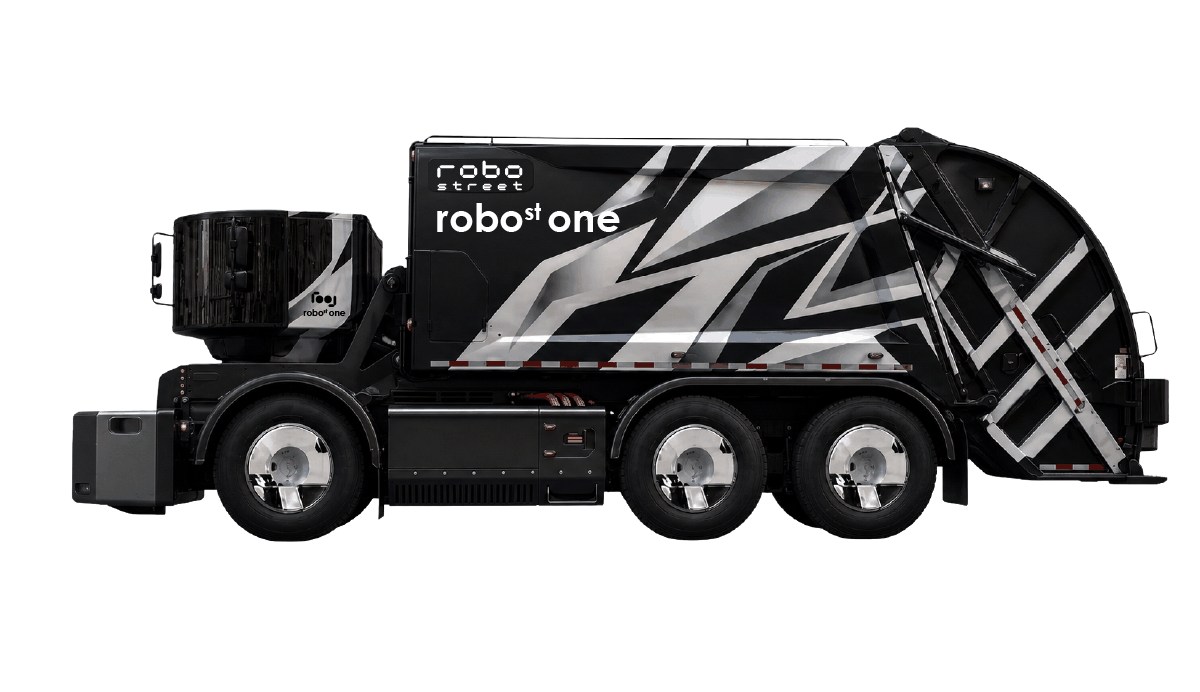
An original Class 8 electric, drive-by-wire, robot-ready cab-and-chassis. One platform providing the structural, energy, motion-control, and data foundation for many industry missions.
Refuse collection is one of the first flagship applications, but it does not define R1's product boundary. From day one, R1 treats the vehicle as a mobile robotic platform: the chassis handles safe motion and energy supply, the upfit handles the industry mission, and autonomy plus Street AI handle mission understanding, coordination, and the operational loop.
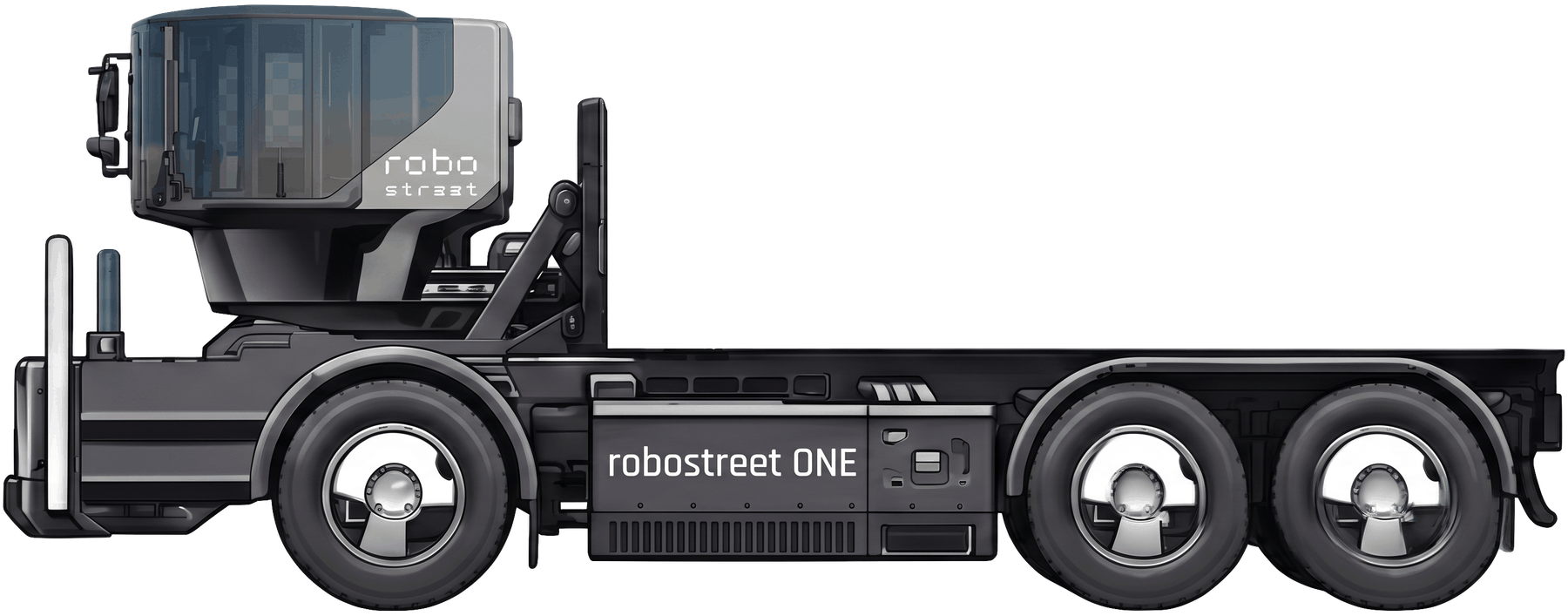
RoboStreet One R1 cab & chassis — the upfit deck stays open; energy and battery packaging hide under the frame.
Cab, energy, by-wire control, upfit interfaces, and intelligent coordination designed together as one vehicle.
A standard mounting grid and electrical / data interfaces adapt the same chassis to many upfits — no reinventing vehicle control per model.
Human driving, driver assistance, and ODD-limited driverless operation share the same physical foundation.
R1's advantage is not a single component — it is the combination of systems in one vehicle architecture. Watch the functional zones light up in sequence.
Values and layout are product-definition-stage targets; final configuration subject to engineering validation. Concept visual — the refuse application is one of R1's flagship showcases.
Lateral seat position + full-cab lift + front boarding — covering both traffic directions and improving frequent entry/exit.
400/600 kWh LFP fully hidden under the frame — freeing side space, lowering CG, protecting the battery.
Direct e-axle output with regenerative braking — efficient, precise at low speed, fewer mechanical links.
By-wire, sensors, compute, and robot safety interfaces — supporting autonomy, manipulators, and multi-device coordination.
A unified energy and motion platform for high-utilization heavy missions. The battery lives inside and under the frame rails as a structurally protected under-frame energy spine — no bulky side battery boxes, leaving room for upfits, tools, pneumatics, cooling, and robot interfaces.
1.2 MW is peak platform capability, not sustained across the whole charge curve — validated after cell, cooling, and infrastructure freeze.
By-wire scope covers propulsion, steering, brake request, parking, gear, regen, cab slide/lift, bumper platform, ePTO, and upfit permissions. Safety-critical actions run on deterministic on-vehicle controllers — cloud and generative AI never enter the steering and braking loop.
Full by-wire, sensor & compute mounts, time sync, data logging, and remote diagnostics.
AEB, surround view, blind spot, auto parking, curb approach, and low-speed work assistance.
Driverless operation inside validated and approved ODDs, with minimal-risk-maneuver capability.
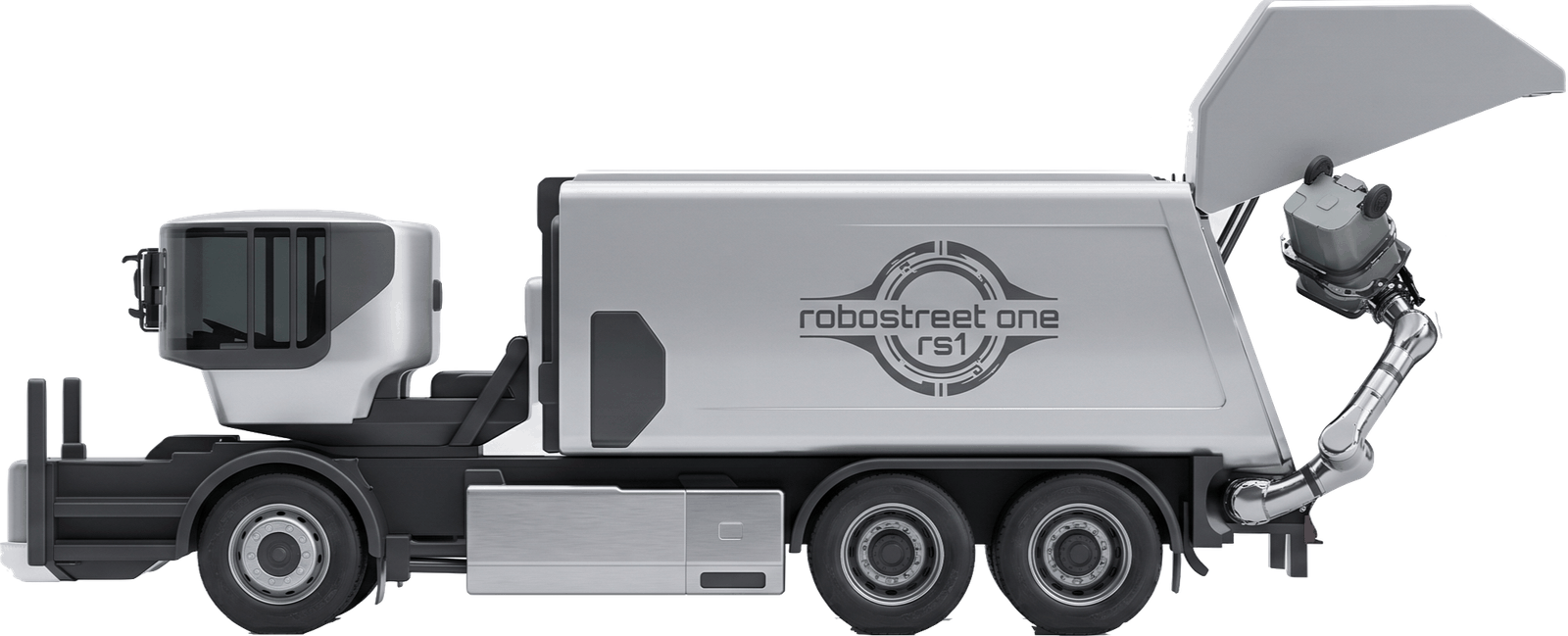
Manipulators, compactors, tool modules, and mobile robots connect through independent safety controllers. Upfits can read vehicle posture, speed, parking, load, and personnel-zone state — but can never bypass the vehicle safety domain to control steering or braking.
robostreet one rs1 — the R1 platform as a robotic refuse truck: the mission module's arm grasps, lifts, and loads while the vehicle safety domain holds e-stop, park permission, and personnel zones.
| Interface | R1 provides | Typical connections |
|---|---|---|
| Mechanical | Standard load rails, hole pattern, and upfit mounting grid | Refuse compactors, manipulators, boxes, service modules |
| Energy | 800 V isolated ePTO, 48 / 24 V auxiliary power | Hydraulic pumps, actuators, sensors, tools |
| Data | Automotive Ethernet, CAN FD, time synchronization | ADS, robot controllers, Street AI gateway |
| Safety | E-stop, park permission, personnel zones, two-way motion authorization | Manipulators, safety PLCs, remote supervision |
The cab slides between left, center, and right locking positions. The same chassis base serves US/EU left-hand-drive and UK/AU right-hand-drive markets; in sanitation or field work the operator can choose the side closer to the curb or work zone.
Design intent: fewer left/right-drive SKUs, better sight lines, and better ergonomics for high-frequency entry/exit missions like refuse collection, utilities, and airports/ports.
robostreet one — the R1 platform bodied as a full electric rear-loader refuse truck.
The product core is always the scalable cab-and-chassis; industry vehicles are defined by upfits and software mission packs.
| Industry | Representative upfit / mission | R1 platform value |
|---|---|---|
| Municipal & Waste | Rear/side loaders, sweeping, robotic collection | Low entry, stop-start regen, ePTO, manipulator coordination |
| Campus & Logistics | Box, flatbed, tractor, fixed-site milk runs | Closed routes, unified dispatch, opportunity charging |
| Utilities & Field Service | Tool bodies, cranes, manipulators, mobile power | On-board energy; crew / tools / robots as one system |
| Energy & Frac Sand | Sand tankers / tractors, private-road convoys | 600 kWh, high payload, site autonomy & fleet coordination |
| Airports & Ports | Low-speed special upfits, cleaning, yard transport | Zero emission, geofencing, high utilization, remote supervision |
Product definition and engineering targets. Production configuration will be frozen per axle loads, upfit, regulation, and supplier validation.
| Item | R1 400 | R1 600 | Notes |
|---|---|---|---|
| Type | Class 8 cab & chassis | Class 8 cab & chassis | Three-axle modular heavy chassis |
| Battery | 400 kWh LFP | 600 kWh LFP | Fully hidden under the frame |
| HV platform | 800 V | 800 V | Traction, charging & ePTO unified |
| Fast charging | Up to 1.2 MW platform | Up to 1.2 MW platform | Actual power varies with battery / SOC / temp |
| Drive | e-axle / 6×2 or 6×4 | e-axle / 6×4 preferred | Axle drive with regen braking |
| Drive power target | ≈500 kW cont. / 800 kW peak | Same | Final per e-axle configuration |
| ePTO target | 125 kW cont. / 250 kW peak | Same | Upfits, hydraulics, manipulators, tools |
| Cab | L/C/R slide + full-cab lift | Same | Stepless front boarding |
| Autonomy | Ready / Assist / ODD L4 | Same | Configured per scenario and permits |
| Highway width target | ≤ 102 in | ≤ 102 in | US National Network design envelope |
| First eng. wheelbase | 186 in | 186 in | Production platform scalable |
| Top speed target | 65–70 mph | 65–70 mph | Software-limited inside driverless ODDs |
"Up to / target / approx." figures are product-definition-stage indicators, not certified or production commitments. Official sales specs correspond to specific vehicle configurations and test reports.
Staged prototypes, benches, and controlled fleets progressively freeze the vehicle and industry configurations.
Frame, cab locking, bumper platform, upfit points, fatigue & crash load paths; insulation monitoring, HVIL, crash cutoff, thermal, water fording, charge interoperability.
Single-fault steering/braking/drive, regen-friction blending, minimal-risk stops; park permission, personnel zones, e-stop, hazardous-energy cutoff.
ODD, remote supervision, software versions, data logging, emergency response, and maintenance flows.
First R1 engineering-validation vehicles are integrated on a Nikola Tre BEV chassis. This describes the early prototype path only — it does not change R1's definition as a RoboStreet original cab-and-chassis vehicle. RoboStreet maintains independent model configuration, BOM, software versions, test records, applicable-standards matrix, and emergency-response documentation for R1.
Reserve your place in the R1 program — configuration and delivery details follow with our team.